
REVIEW: Moonwalking with a Debut Graphic Novel: Mysteries of the Mountain Moon Tribe
I’ve long been a massive fan of fantasy and comics, so I was thrilled to have been asked by Our Street Books (an imprint of Collective Ink) to provide a review of Jack Ruedisueli’s Mysteries of the Mountain Moon Tribe. Our Street Books was generous enough to provide me with an early access copy of the book before its debut date on April 28, 2026.
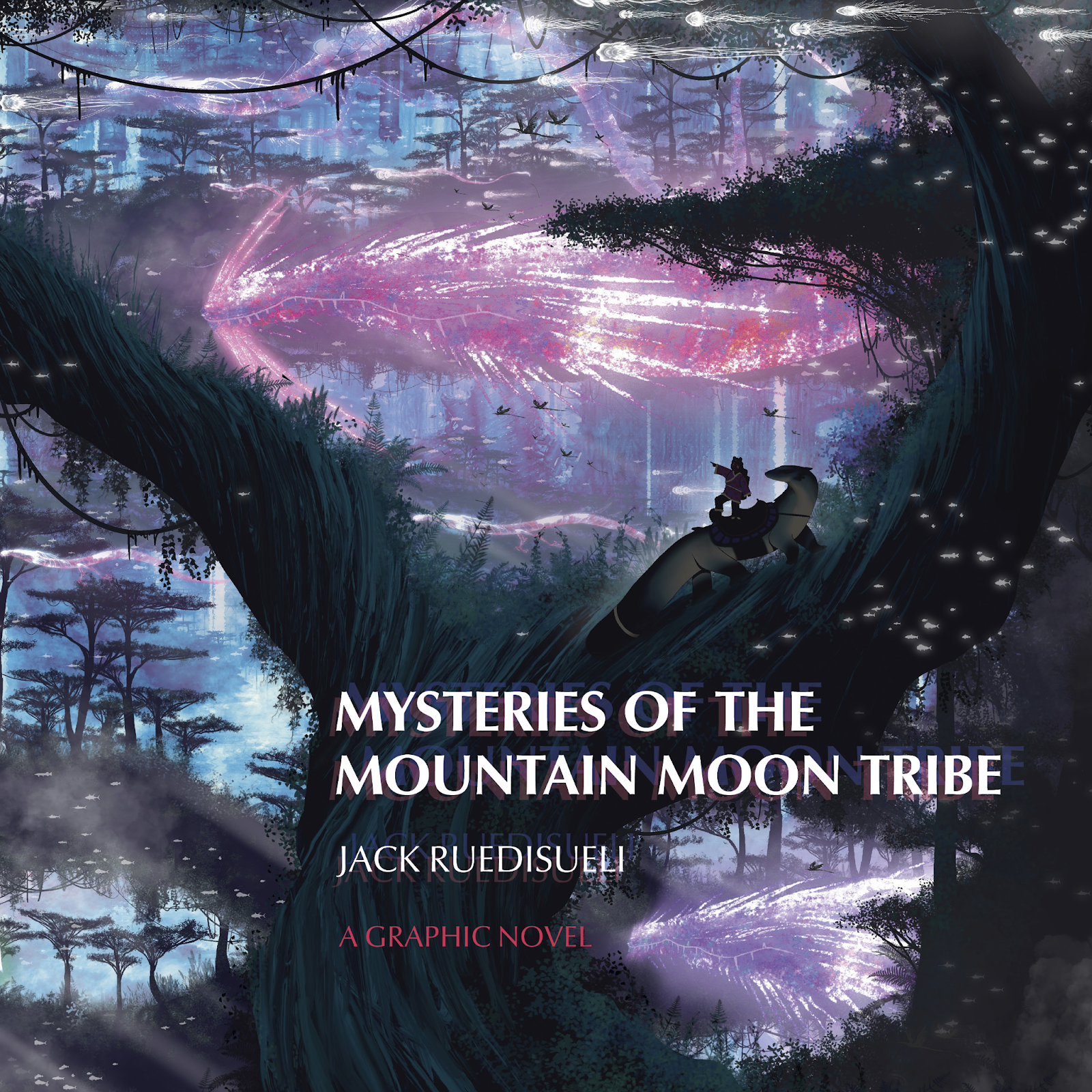
Cover for Mysteries of the Mountain Moon Tribe.
Mysteries of the Mountain Moon Tribe is a YA graphic novel written by debut writer and artist Jack Ruedisueli’s. The story follows a young tribal elder, 13-year-old Mia, who must undertake a dangerous journey along with her huge pet ferret to heal her village from a terrible fate. To help her family and community, she must seek out the ancient spirit that dwells within the heart of the mountain.
The art in this book is the focal point, providing the reader with a unique and original take on the book’s universe (think somewhere along the lines of cross-section between studio Ghibli and Jim Henson’s The Dark Crystal). Particularly strong and stunning are the broad panels, which provided breathtaking ‘snapshots’ of the imaginative world of the book. By contrast, the depictions of the main characters are often portrayed in small scale in comparison to the vast world that contains them. This stark contrast between the visually ‘often out of focus’ main characters and the enormity of the world served as an interesting thematic undertone of the book, which plays out quite intentionally in the climax (of which I won’t spoil here). The world itself serves as the subject matter of the book, with the characters existing within a living, breathing world.
The story also takes part within the universe of the book and provides some interesting plot twists, particularly in the latter part of the book. Much of the beginning of the book is focused on Mia’s environment, her family and everyday lived experience within her village, while the middle of the book serves to undermine everything that she previously thought about her lands beyond her village. Her journey serves to explore the unknown regions of her universe, while she makes her way towards the mountain.
I also wanted to provide some analysis of the inspirations for the book. The book draws heavily from several diverse mythological traditions, both on the visual and thematic levels. Visually speaking, the world of the book and several of the creatures featured therein appear to draw broadly from diverse religious and mythological traditions, especially from Japanese and Mesoamerican folklore. The weasel, for instance, has a long and rich intercultural symbolic history within mythology. For example, in Japan, the Kamaitachi is a yokai that takes on the form of weasel, and, in Norh American traditions, weasels are diversely depicted as heroes and tricksters. This rich background implied by the symbol of Mia’s ferret then sets up an ambiguity for the way that the animal in the book should be understood and what his role in the story will be.
On the level of storytelling, the work’s cosmology is intriguing, replete with a myriad of monsters and spirits. The diversity of creatures in the story is matched by the narrative itself, which considers the relationship between the human and the divine (incidentally also a common theme in Ghibli films). The story begs the reader to consider the relationship between creator and creatures within its universe, here drawing from both Eastern and Western conceptions. While the cosmogony of the book is related to Platonic notions of creator and demiurge, the comparison is far from identical. Given the prevalence of the theme of ‘creation’ is in the book, it would have been a bonus to have a few more visuals depicting creation itself in the latter portion of the book.
Overall,I quite enjoyed the work, particularly the book’s broad and expansive panels with expressive and beautiful colors splashed throughout. I’m excited to follow Jack Ruedisueli’s budding and promising career.
Until our paths should cross again!